
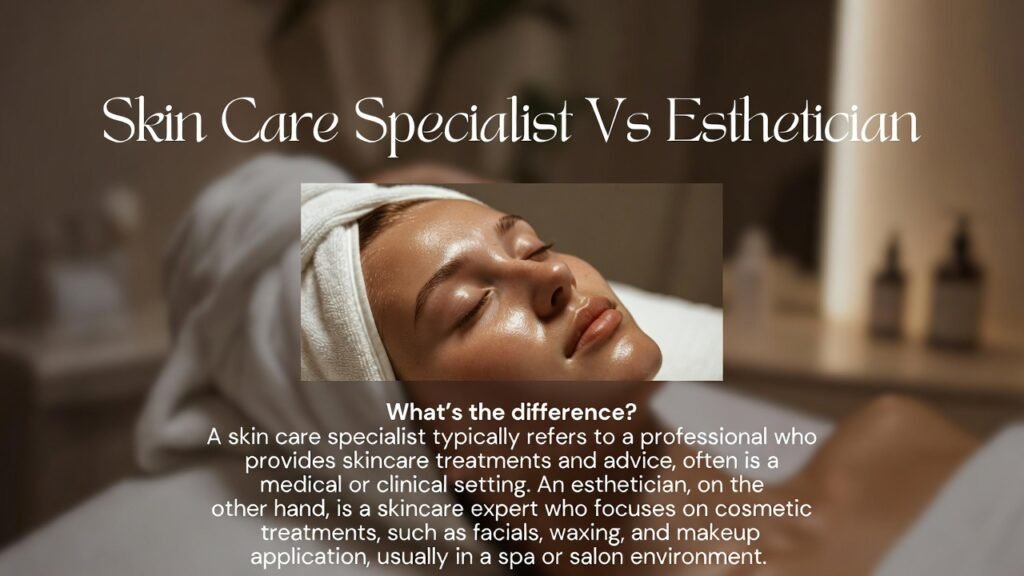
An esthetician is licensed; skin care specialist is a broader, often unregulated title.
If you have ever wondered what is the difference between skin care specialist and esthetician, you are not alone. I’ve trained teams in spas and medical offices, and I’ve seen how these titles confuse clients and new pros. In this guide, I break down what is the difference between skin care specialist and esthetician in plain language, with real examples, current industry standards, and tips you can use today.

What is the difference between skin care specialist and esthetician?
When people ask what is the difference between skin care specialist and esthetician, the short version is this: esthetician is a licensed, regulated profession. Skin care specialist is a broad job label.
Skin care specialist can mean many things. It can include licensed estheticians, makeup artists, beauty advisors, and even medical assistants who support dermatology. It is not a legal license by itself.
Esthetician is a license issued by a state board. It allows non-medical skin care services. Some states use cosmetology boards. Others use barbering and cosmetology boards. You must meet education hours and pass exams.
When you see job posts, many use both terms. That adds to the mix-up. So when you ask what is the difference between skin care specialist and esthetician, the key is the license. Ask to see it. Verify it with the state.
Scope of practice and services
This is where the real difference shows up in daily work. It also explains what is the difference between skin care specialist and esthetician in a client’s eyes.
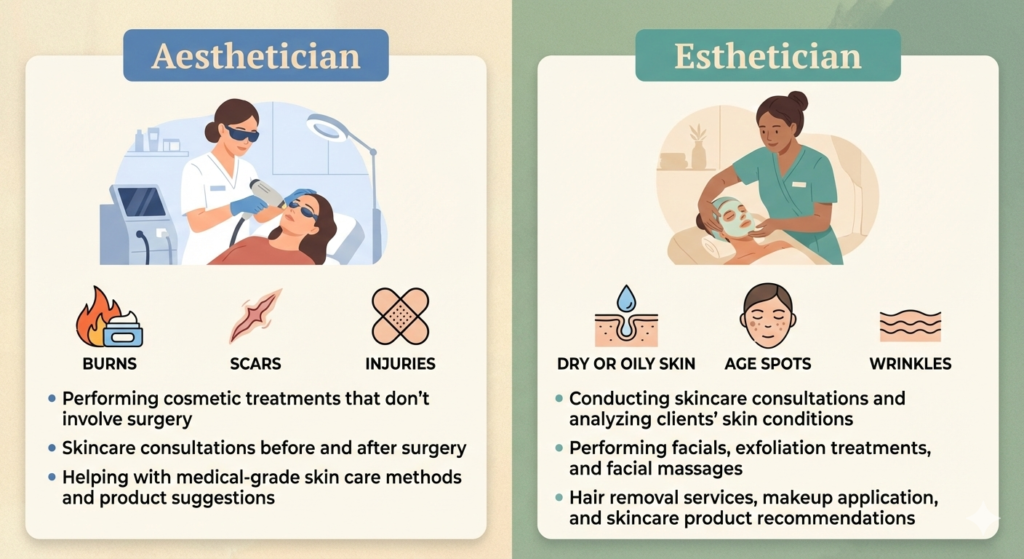
What licensed estheticians can do, depending on state rules:
- Facials and basic peels. Includes cleansing, exfoliation, extractions, and masks.
- Hair removal. Includes waxing, sugaring, tweezing, and sometimes threading.
- Makeup services. Special event makeup and lessons.
- Body treatments. Body wraps, scrubs, and back facials.
- Device-based services within scope. Microdermabrasion, LEDs, and dermaplaning in some states.
What estheticians cannot do in most states:
- Diagnose skin diseases. Only medical professionals can diagnose.
- Prescribe or inject. No fillers, Botox, or Rx products.
- Use medical lasers or deep peels. These fall under medical direction in many states.
What a skin care specialist might do without a license:
- Retail advice. Product education and shade matching.
- Spa front desk or assistant roles. Client care, not hands-on services.
- Social content and education. Skincare tips with no treatments.
Always check your state board. State rules define scope. This is core to what is the difference between skin care specialist and esthetician.
Education, licensing, and certifications
Education and licensing answer much of what is the difference between skin care specialist and esthetician.
Typical esthetician path:
- School hours. Many states require 300 to 1,000 hours. A common range is 600 to 750.
- Written and practical exams. You must pass both to earn a license.
- Renewal. Licenses renew every one to two years. Some states require continuing education hours.
- Advanced training. Medical aesthetics courses, chemical peels, and device training under approved providers.
Popular certifications for estheticians:
- NCEA Certified. National credential for advanced esthetics knowledge.
- CIDESCO Diploma. International standard and advanced practice.
- Manufacturer training. For peels, devices, and safety.
Skin care specialist path:
- May have no mandated training. Some roles require brand training only.
- Retail or spa onboarding. Focus on sales and customer care.
- No state license needed for non-touch roles.
If you plan a career, this is where what is the difference between skin care specialist and esthetician matters most. The license opens doors, protects clients, and increases income potential.
Work settings and day-to-day duties
Workplaces also show what is the difference between skin care specialist and esthetician.
Common esthetician settings:
- Day spas and salons. Classic facials, waxing, and brows.
- Medical spas and dermatology clinics. Advanced services under clinical protocols.
- Resorts and cruise ships. High-volume guest services.
- Solo studios. Niche services and loyal clients.
Common skin care specialist settings:
- Beauty retail. Product advice, mini demos, and events.
- Content creation and brand education. Online or in-store training.
- Front desk or coordinator roles. Client intake and scheduling.
Daily work for estheticians:
- Consults and skin analysis. Set goals and track progress.
- Service plans. Build series and home care.
- Sanitation and safety. Follow state rules.
- Records and follow-ups. Document and review results.
Tools, techniques, and product knowledge
Devices and ingredients can blur lines, so it helps to map them when asking what is the difference between skin care specialist and esthetician.
Typical esthetician tools:
- Microdermabrasion and dermaplaning. Where allowed by the state.
- Ultrasonic spatulas and LEDs. Noninvasive support devices.
- High frequency and galvanic. Classic spa equipment.
- Professional peels. Alpha- and beta-hydroxy acids with safety protocols.
Products estheticians master:
- Sunscreens and retinoids. How to layer and avoid irritation.
- Acids and enzymes. Choosing strength and pH for goals and safety.
- Barrier care. Ceramides, cholesterol, and fatty acids for repair.
Tools often reserved for medical settings:
- Lasers and IPL. Often require medical oversight.
- Medium to deep peels. Physician-level acids and strengths.
- Microneedling with depth. Often medical-only needles and protocols.
A skin care specialist in retail may know ingredients well. But hands-on use of pro tools belongs to licensed pros. That detail anchors what is the difference between skin care specialist and esthetician in real life.
Career paths, pay, and growth
Pay varies by location, setting, skills, and retail sales. Industry reports and labor data show steady growth in personal care and clinical aesthetics.
Typical esthetician earnings:
- Base pay plus tips. Often boosted by retail and service commissions.
- Medical settings pay more. Extra training increases value.
- Ownership potential. Solo studios can scale with packages and membership models.
Skin care specialist earnings:
- Hourly plus retail bonus. Common in retail and brand roles.
- Growth via education roles. Field trainer or brand educator paths.
Ways to grow faster as an esthetician:
- Build a niche. Acne, age management, brows, or corrective peels.
- Track results. Before and after photos and progress charts.
- Loyalty programs. Packages and memberships for retention.
- Partner with clinics. Cross-referrals with dermatology and injectors.
This is one more angle of what is the difference between skin care specialist and esthetician. Licensing expands what you can do and what you can earn.
How to choose the right professional for your skin
Use this simple plan when you wonder what is the difference between skin care specialist and esthetician and who to book.
Steps to choose well:
- Check the license. Ask for the esthetician’s license number and verify it.
- Ask about scope. Confirm which services are within their state rules.
- Review training. Look for recent courses and device certifications.
- Request a consult. Share goals, budget, and timeline.
- Start simple. Try one service and a short home routine first.
Red flags to avoid:
- No license on display for hands-on services.
- Promises of medical results without medical oversight.
- Lack of consent forms or aftercare instructions.
Personal insights and real-world examples
In my early spa days, I learned fast that trust is earned. A client came in after a harsh peel from an unlicensed “skin care specialist.” Her skin was inflamed. We switched to barrier repair. Short facials. Simple actives. In six weeks, her skin calmed and her confidence grew.
In a clinic, I supported acne clients who had a dermatologist. We aligned care. I did extractions, enzyme peels, and coached routines. The doctor handled prescriptions. Results were better and safer. This is what is the difference between skin care specialist and esthetician in action: teamwork within scope.
Lessons I live by:
- Skin likes slow. Add one change at a time.
- Sunscreen is the foundation. Every day, every season.
- Track progress. Data beats guesswork.
- Respect scope. Safety builds long careers.
How to become an esthetician or skin care specialist
If you are planning a career and asking what is the difference between skin care specialist and esthetician, follow these steps.
Steps to become an esthetician:
- Research your state rules. Confirm required hours and exams.
- Tour schools. Compare costs, schedules, and pass rates.
- Build your kit. Start lean and add as you grow.
- Pass exams. Book early and practice often.
- Get insured. Professional liability is a must.
- Keep learning. Take advanced classes and track your CE hours.
Paths to become a skin care specialist without hands-on services:
- Learn ingredients. Study basics of formulations and skin types.
- Work retail. Gain face-to-face practice and sales skills.
- Create content. Share helpful tips and honest reviews.
- Move into education. Train teams as you gain brand experience.
Common myths and mistakes
These come up often when people search what is the difference between skin care specialist and esthetician.
Myths to skip:
- All skin care specialists are licensed. Not true. Check the license.
- Estheticians can do medical lasers everywhere. Rules vary by state.
- More products mean better skin. Often the opposite. Keep it simple.
- Only expensive services work. Consistency wins. Sunscreen and routine matter most.
Mistakes to avoid:
- Skipping patch tests with new actives.
- Ignoring sun care after peels or waxing.
- Mixing too many actives at once.
Frequently Asked Questions of what is the difference between skin care specialist and esthetician
Is a skin care specialist the same as an esthetician?
Not always. A skin care specialist can be any beauty worker in skin care. An esthetician is a licensed professional who provides non-medical skin treatments.
What services can an esthetician do that others cannot?
Estheticians can perform facials, extractions, waxing, and certain peels within state rules. Unlicensed staff cannot perform hands-on services.
What is a medical esthetician?
It is an esthetician working in a medical setting with added training. The base license is the same, but services follow medical protocols and oversight.
How do I verify an esthetician’s license?
Ask for their license number and state. Check the state board’s website or call to confirm it is active.
Does every state use the same rules?
No. Scope, devices, and hours vary by state. Always review your state board to confirm what is allowed.
Why do job ads use both terms?
Employers use broad language to reach more applicants. Clarify the role and confirm if a license is required.
Can a skin care specialist recommend products?
Yes, anyone can recommend products. But treatment plans and pro peels should come from a licensed esthetician.
Conclusion
The heart of what is the difference between skin care specialist and esthetician is simple. Skin care specialist is a broad label. Esthetician is a licensed, regulated professional who works within a defined scope. That license safeguards your skin and the services you receive.
Use what you learned to book smarter, build a routine that works, and see steady results. If you are career-minded, choose the licensed path for more options and long-term growth. Want more guides like this? Subscribe, share your questions in the comments, and tell me what you want to learn next.