
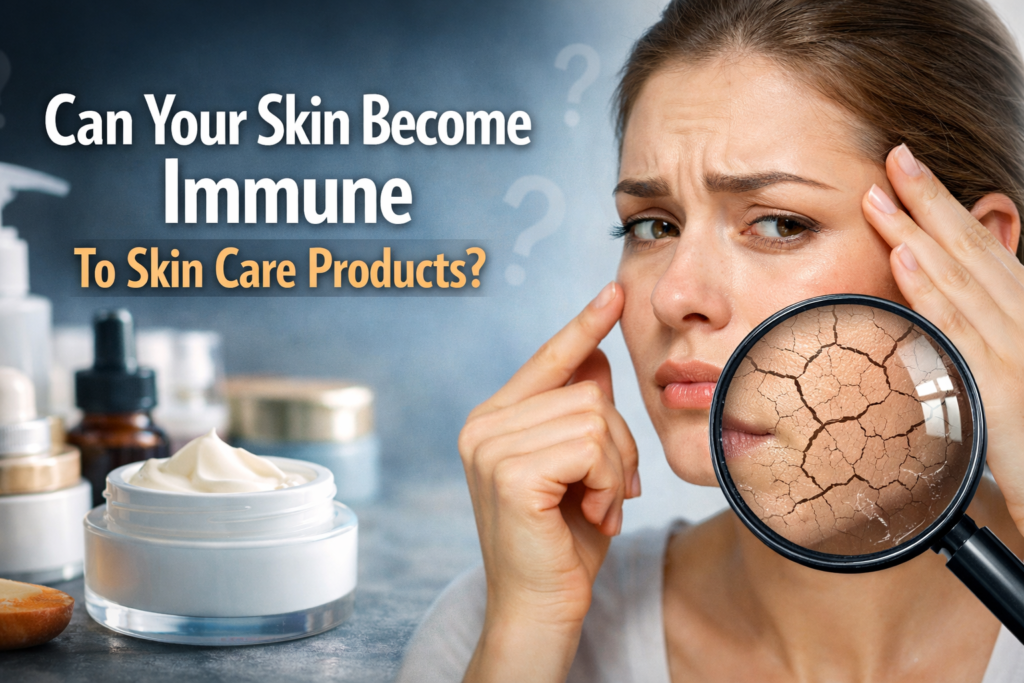
No, your skin does not become immune; it adapts, plateaus, or gets irritated.
That quick line covers the heart of the topic, but there is much more to it. If you have wondered can your skin become immune to skin care products, you are not alone. I have helped many clients work through plateaus, irritation, and confusion about results. In this guide, I explain what is going on under the surface, why routines stall, and how to keep seeing progress without wrecking your barrier.
Can your skin become immune to skin care products? What it really means
The short answer is no. Skin does not build a true immune shield to most actives. What you feel as “immunity” is often adaptation, irritation, or a change in your baseline.
Disclaimer: This information is for educational purposes only and does not constitute medical advice. Always seek the advice of a physician or other qualified health provider regarding a medical condition.
When people ask can your skin become immune to skin care products, they are seeing fewer visible changes over time. That is common. Once your skin improves, the big changes slow down. You are closer to your goal, so the shift looks small. That is not immunity. It is a normal plateau.
Also, some formulas break down, or your usage slips. That makes results fade. And sometimes your skin barrier gets stressed, so you need to reset before you push again.
How skin adapts: biology in simple terms
Your skin renews itself in cycles that last about four weeks. It reacts to stress, light, and climate. It also calms when you give it time and a gentle routine.
When you wonder can your skin become immune to skin care products, remember this: cells do not become immune, they respond. Receptors can get saturated. Irritation can reduce use. Barriers can heal and then allow better results.
This is why slow, steady use wins. You want your barrier strong and flexible. That is how actives work best.
Why products seem to “stop working”
If you feel stuck, it is usually one of these reasons:
- Diminishing returns. As your skin clears or brightens, each gain is smaller.
- Inconsistent use. Skipped nights and tiny doses reduce results.
- Product instability. Vitamin C can oxidize. Sunscreen filters degrade with heat. Retinoids lose punch if stored poorly.
- Barrier damage. Over-exfoliation blocks progress and causes dull, reactive skin.
- Seasonal or hormonal shifts. Winter dryness, summer oiliness, stress, or cycles can change your needs.
- Formula change. Brands sometimes tweak formulas without notice.
- Wrong target. Dark spots from hormones will not fade fast with a mild exfoliant alone.
Each point above can feel like can your skin become immune to skin care products, but it is not immunity. It is a fixable mismatch.
When to change your routine and when to wait
It helps to use a simple test. Ask yourself three things:
- Have I used the product as directed for 8 to 12 weeks?
- Is my skin barrier calm, with no stinging or flakes?
- Do I track progress with photos in the same light?
If yes, and there is no progress, it may be time to adjust. If not, wait, repair, or log data first. Many people ask can your skin become immune to skin care products when the real fix is patience and proof.
Smart ways to rotate actives without losing results
You can keep results fresh with planned steps, not random swaps.
- Micro-adjust dose. Use a pea-size retinoid, not a dab that grows each night.
- Step up strength. Move from 0.025% to 0.05% retinoid after 8 to 12 weeks if your skin is calm.
- Change frequency. Use your acid two nights a week instead of four if you are dry, or vice versa if you are oily and tolerant.
- Pair actives well. Vitamin C by day and retinoid by night is a classic combo.
- Cycle wisely. Do 3 nights gentle, 1 night active, 3 nights gentle when your barrier needs care.
People often ask can your skin become immune to skin care products if they feel a stall. These tips help you move past stalls and protect your barrier.
Troubleshooting guide: common cases and fixes
These are real patterns I see often.
- Vitamin C stopped brightening. Check color and smell. If it is dark or smells like metal, it oxidized. Switch to a fresh bottle or an airless pump.
- Retinoid no longer smooths texture. You may be using too little or too rarely. Track actual usage, then step up strength or add a gentle AHA night.
- Acne flares on benzoyl peroxide. It likely is a stress, cycle, or sunscreen pore issue. BPO does not cause bacterial resistance the way antibiotics do. Keep BPO steady and fix the trigger.
- Exfoliant burns but “does nothing.” That is barrier damage. Stop actives for 1 to 2 weeks. Use ceramides, glycerin, and petrolatum. Then reintroduce slowly.
If you thought can your skin become immune to skin care products in any of these, now you know where to look first.
My real-world lessons from clients
A client swore her niacinamide “quit.” We found she had cut her sunscreen use. Spots came back due to sun, not “immunity.” We added daily SPF, and clarity returned.
Another client felt her retinoid stalled. We moved from two nights a week to three, then four. We added a simple moisturizer sandwich. Texture improved again in six weeks.
These stories echo a key point. When you ask can your skin become immune to skin care products, check the routine, the dose, and the barrier before you blame the ingredient.
Myths and truths about tolerance, purging, and plateaus
Let’s clear the air.
- Myth: Your skin gets immune to retinoids. Truth: Your skin gets used to the irritation. The benefits continue with time and proper use.
- Myth: Acids stop working in a month. Truth: As your skin gets smoother, results look less dramatic, but maintenance is still value.
- Myth: More products fix plateaus. Truth: Better timing, storage, and dose do more.
- Myth: Strong equals better. Truth: The best routine is the one you can sustain.
So, can your skin become immune to skin care products? Not in the way most people think. You are seeing normal adaptation.
Safe progression by skin type
Different skin types need different paths.
- Sensitive or reactive. Start one active at a time. Use it once a week, then twice. Sandwich with moisturizer. Keep a barrier serum on deck.
- Oily or acne-prone. Use BPO or salicylic acid and a retinoid on alternate nights. Watch for dryness and add a simple moisturizer.
- Dry or mature. Focus on ceramides, cholesterol, and fatty acids. Use gentle acids, low-strength retinoids, and daily sunscreen.
- Deeper skin tones. Be cautious with strong acids and hydroquinone. Fade care should be slow and steady to avoid rebound darkening.
In each case, the question can your skin become immune to skin care products is more about pacing, not power.
Evidence check: what research and clinics observe
Here is what expert practice and studies show:
- Most cosmetic actives do not trigger true biological immunity in skin cells.
- Tolerance to irritation is common. Efficacy often continues or improves with steady use.
- Product stability matters. Oxidized vitamin C and heat-damaged sunscreen lose potency.
- True tachyphylaxis happens with topical steroids. These are medicines, not daily skincare. Use them only as prescribed.
- Bacteria can resist antibiotics, but benzoyl peroxide maintains effect. That is a key difference.
Thus, when you ask can your skin become immune to skin care products, the science says no for most over-the-counter actives. Look to stability, dose, frequency, and barrier health instead.
Frequently Asked Questions of can your skin become immune to skin care products
Can your skin become immune to skin care products over time?
No. Skin does not develop true immunity to most actives. What you see is adaptation, poor storage, or inconsistent use.
How do I know if I hit a plateau or need a stronger product?
Track photos for 8 to 12 weeks. If there is no change and your barrier is calm, consider a small bump in strength or frequency.
Does rotating products stop “immunity” from happening?
Rotation helps avoid irritation and boredom. It does not prevent immunity because can your skin become immune to skin care products is not the real issue.
Why did my vitamin C stop working?
It may have oxidized or you may be using too little. Replace the bottle and use sunscreen daily for best results.
Can bacteria become resistant to benzoyl peroxide?
Benzoyl peroxide keeps working because of its mechanism. Resistance is more a risk with antibiotics, not BPO.
Do I need to take breaks from retinoids?
Most people do not need breaks once tolerance is built. Take a short break only if you have irritation or barrier trouble.
Conclusion
Skin does not become immune to products, but it does adapt. Results slow as your baseline improves, and issues like oxidation, dose, and barrier health play a big role. The smarter question than can your skin become immune to skin care products is how you can keep results steady and your barrier strong.
Pick one tweak today. Log your routine, check storage, or adjust frequency. Small, steady steps beat swings and hype. If you want more guides like this, subscribe, bookmark this page, or share your routine wins in the comments.